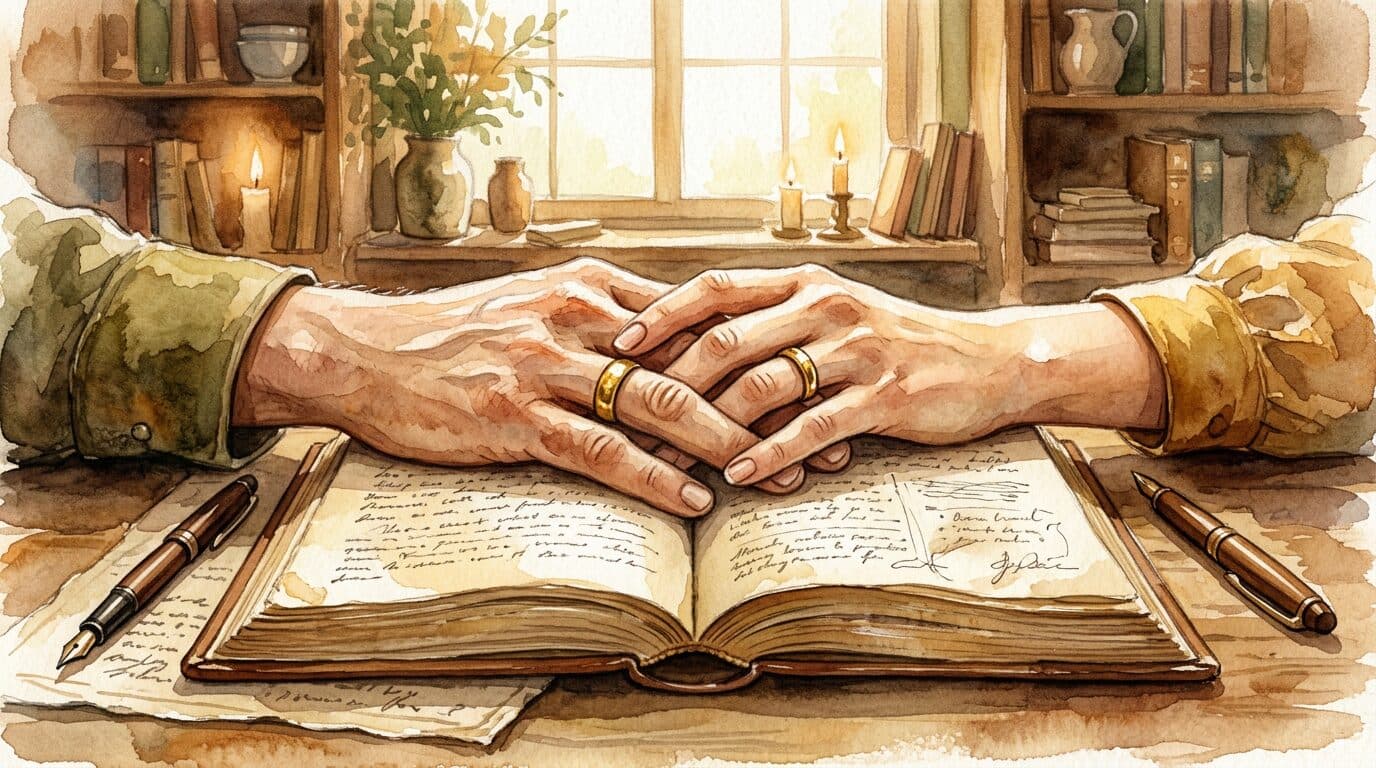
You remember the first date vividly. So does your spouse. And your versions are completely different. You say you were charming. They say you were nervous and talked too much about your car. You remember the restaurant as intimate. They remember it as loud. You both remember the evening as the beginning of everything.
That is what makes a couple's love story so interesting: it is the same story told from two perspectives, and the differences between the versions are as revealing as the similarities.
Why Couples Should Tell Their Story Together
A love story told by one person is a memoir. A love story told by both people is a conversation, richer, funnier, and more honest than either version alone.
When couples record their stories separately and the accounts are woven together, something magical happens: the reader gets to see each person through the other's eyes. You learn what your mother saw in your father, and what your father saw in your mother, and the combination is more complete than any single perspective could be.
The disagreements are part of the charm. "He says he called me the next day. He called a week later. I was about to give up on him." These contrasts make the story feel real, because real relationships are built on two imperfect memories of the same imperfect events.
Anniversary Projects
A couple's love story makes a natural anniversary project, especially milestone anniversaries (25th, 40th, 50th). Instead of a party or a trip, you create a record of the life you built together: how you met, the proposal, the early years, the hard times, the best times, and what you have learned about each other over decades.
For children and grandchildren, this is one of the most treasured family documents possible. It is not just a love story. It is the origin story of their family, told by both of the people who started it.
How to Do It
Record separately. Each person should tell their version independently, without the other person in the room. When both people are present, one tends to defer to the other ("You tell it, you remember it better"), and the unique perspectives get lost. The whole point is to capture what each person noticed, felt, and remembers.
Start with the same prompts. Give both people the same questions:
When did you first notice each other?
What was your first impression?
When did you know this was serious?
What is the hardest thing you have been through together?
What do you know about your partner now that you did not know in the first year?
What would you tell a younger version of yourself about this relationship?
The answers to the same questions, told from different vantage points, naturally create a dual-perspective narrative that is far more engaging than a single account.
Include the ordinary. Love stories are not just about the big moments (the wedding, the birth of a child, the crisis survived). They are about the daily texture: the morning routine, the inside jokes, the way you divide household tasks, the thing your partner does that used to annoy you and now makes you smile. These details are what make a love story feel like a real marriage rather than a romance novel.
Handling Difficult Chapters
Most long relationships include chapters that are hard to talk about. A period of distance. A betrayal. A time when you were not sure you would make it. Deciding whether to include these chapters is a decision you make together.
If you both agree to include a difficult period, let each person tell their version. The result is often surprisingly healing, because hearing how your partner experienced the same painful time can reveal things you never understood about each other. "I thought he did not care. When I read his version, I realized he was terrified."
If one person does not want to include something, respect that. A couple's love story is a collaborative project, and both parties have veto power over shared material. Our guide on when family members remember things differently covers how to navigate competing versions with grace.
What Your Children Will Read
Your children know you as parents. They know the household rules, the family routines, the way you interact in the kitchen. What they do not know is how you got here. They do not know the people you were before they existed, the young couple who fell in love in a world the children have never seen.
A couple's love story fills that gap. It introduces your children to the people you were at twenty-two, at thirty, at forty, before the gray hair and the reading glasses. It shows them that you were once young, uncertain, and wildly in love, and that the love changed shape but never disappeared.
For children, this reframes the family. Mom and Dad are not just Mom and Dad. They are two people who chose each other, and kept choosing each other, and built a life that the children grew up inside without ever seeing the foundation.
Making It Real
With Journtell, each person records their memories separately. Their individual Story Teams preserve each person's unique voice and perspective. The stories can then be arranged together, alternating perspectives or running side by side, creating a love story that honors both the similarities and the differences in how you experienced your life together.
For the complete guide to writing your life story, whether solo or as a couple, our comprehensive guide covers everything. And if you are thinking about this as a gift for someone else's anniversary, our piece on life story books as wedding gifts covers the gifting side.
Two perspectives. One love story. A book your family will read for generations. Start writing your love story today.
Ready to write your life story?
Journtell makes memoir writing effortless. Just speak or type your memories, and your Story Team turns them into a beautifully written book.
Start Writing Free