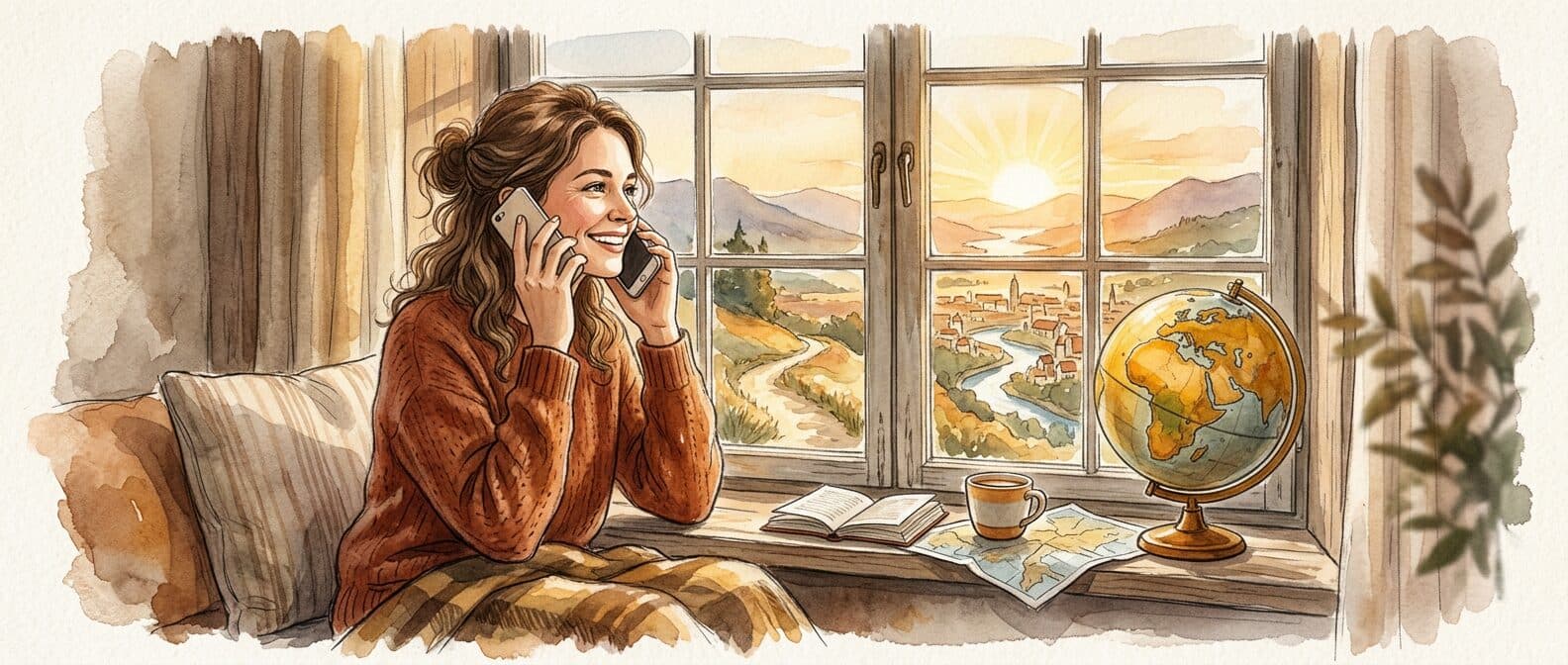
Your mother lives in Florida. You live in Oregon. Your grandmother is in the Philippines. Your brother is in London. This is how modern families work: scattered across cities, states, time zones, and continents, connected by phone calls, video chats, and group messages.
When it comes to preserving family stories, distance feels like an obstacle. You imagine that the ideal scenario is sitting together at the kitchen table, camera rolling, stories flowing naturally over coffee. And yes, that scenario is wonderful. But it is not the only scenario, and waiting for the perfect in-person opportunity is how stories get lost.
Here is how to capture family stories from anywhere.
The Phone Is Enough
The most underrated tool for recording family stories is the phone call. Not a video call. A regular phone call.
Video calls have their place, but they also create performance anxiety. The person on camera is aware of being watched, and that awareness can make them stiffer, more self-conscious, and less likely to wander into the kind of unplanned storytelling that produces the best material.
A phone call is intimate. It is the format your parents are most comfortable with. There is no camera to fuss over, no lighting to worry about, no "Can you see me? Can you hear me?" negotiations. Just two people talking, the way families have been connecting across distance for decades.
If you want to record the call (with their knowledge and permission), most smartphones have built-in recording features or simple apps that capture both sides. Let them know you are recording and why: "I want to remember this conversation. Is that okay?"
Asynchronous Recording Works Too
You do not have to be on the call at all. If your family member uses Journtell, they can record stories on their own schedule, whenever a memory surfaces, without coordinating with anyone. This is often the most natural approach: they are alone, comfortable, and free to talk without worrying about taking up someone's time.
You can support this by sending prompts. A text message: "Mom, I was thinking about Grandma's house today. Do you remember the garden? Would you record that memory?" A prompt gives direction without requiring coordination. They record when they are ready, and you get to hear the story later.
Making Remote Sessions Feel Intimate
If you do schedule a live recording session over phone or video, a few adjustments make the experience warmer:
Choose the right time. Schedule when the storyteller is relaxed and alert, not squeezed between other obligations. Sunday morning is usually better than Wednesday evening. Give it at least an hour, even if the recording only lasts twenty minutes, so nobody feels rushed.
Minimize distractions. Ask them to sit somewhere quiet. Turn off the television. Close the door. The physical environment matters even over the phone, because background noise and interruptions break the flow of memory.
Start with something easy. Do not open with "Tell me about your life." Start with a specific, low-stakes question: "What was the first car you ever owned?" or "What did you eat for dinner growing up?" Small questions open the door. Big questions slam it shut.
Let them talk. The most important thing you can do in a remote recording session is stop talking. Ask a question, then listen. Do not fill silence. Silence is where memories surface. If they pause for ten seconds, that is not your cue to ask another question. That is your cue to wait. The story is coming.
React warmly. Laugh when something is funny. Say "I did not know that" when something surprises you. Let them hear that you are genuinely interested. Over the phone, without visual cues, your vocal reactions are the only way they know you are engaged.
Working Across Time Zones
If your family spans multiple time zones, scheduling becomes a challenge. A few strategies:
Find the overlap. There is usually a window, even if small, where both parties are awake and reasonably alert. Sunday mornings for you might be Sunday evenings for them. That overlap is your window.
Use asynchronous recording. If the time zones are too far apart for comfortable live conversation, switch to the prompt-and-record model. You send a question. They record when convenient. You listen when convenient. No coordination needed.
Rotate the inconvenience. If someone always has to take the call at an odd hour, alternate who that someone is. Fairness matters, especially over long projects.
When You Finally Visit in Person
If you do get to visit, make the most of it. Bring old photographs (they are the best memory triggers, as our guide on using old photos to unlock stories explains). Visit places from their past if you can. Cook a family recipe together. These shared activities unlock stories that direct questioning cannot reach.
But do not put all your eggs in the in-person basket. Visits are short, holidays are hectic, and there is never as much time as you think. The remote sessions you do between visits are often more productive than the visit itself, because they are calmer, less crowded, and more focused.
Starting the Conversation from a Distance
If you have not yet broached the subject of recording family stories, distance can actually make the conversation easier. A one-on-one phone call is often more intimate and less intimidating than a face-to-face request at a family gathering.
Our guide on recording your parents' stories covers how to start the conversation, and our collection of questions to ask elderly parents gives you specific starting points that work over the phone as naturally as they work in person.
Distance Does Not Have to Mean Distance
Geography is a challenge, not a barrier. The most important ingredient in preserving family stories is not physical proximity. It is interest. If you care enough to ask, the stories will come, regardless of how many miles separate you.
With Journtell, your family member can record stories from anywhere, on any device, at any time. Their Story Team shapes each memory into a polished story, and the book builds progressively. You do not need to be in the same room. You do not even need to be on the same continent. You just need someone who is willing to remember.
Start preserving your family's stories today, wherever they are.
Ready to write your life story?
Journtell makes memoir writing effortless. Just speak or type your memories, and your Story Team turns them into a beautifully written book.
Start Writing Free