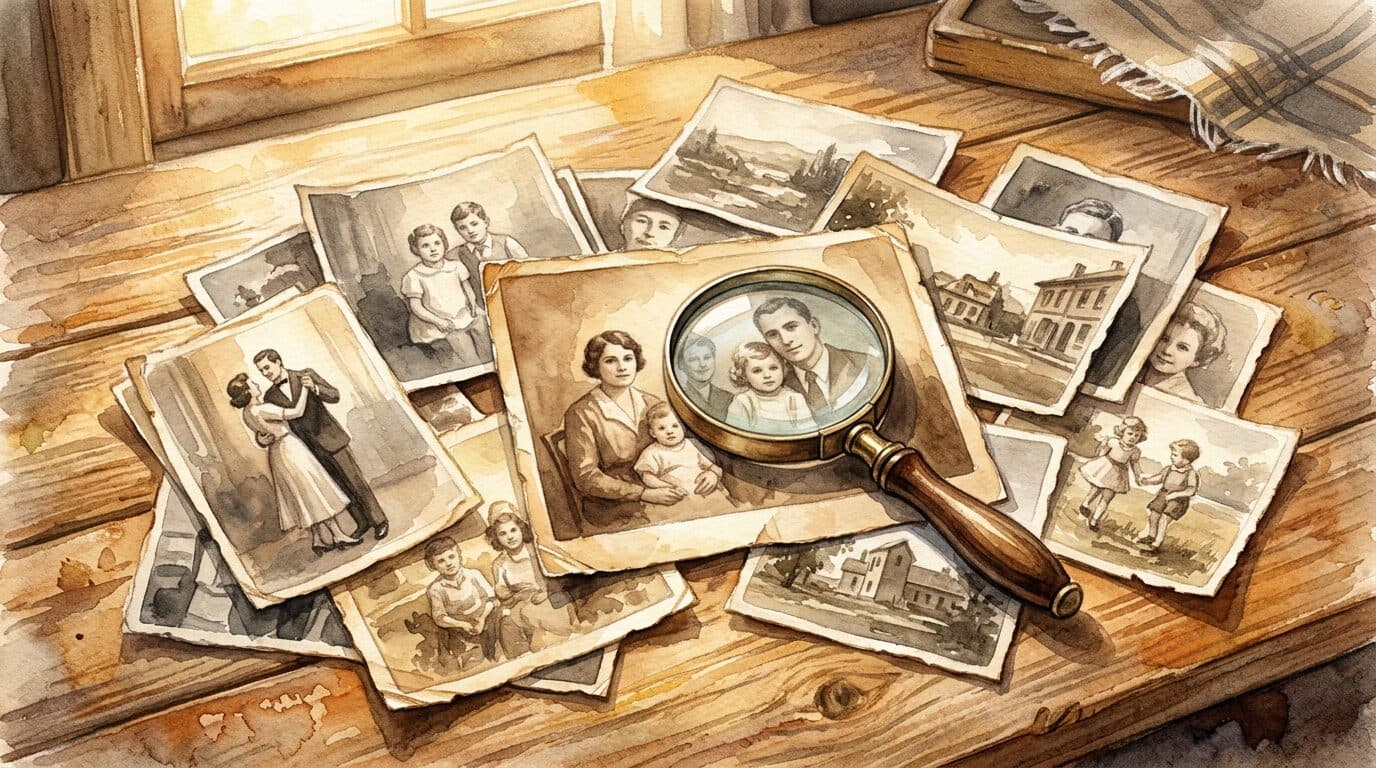
Somewhere in your house, there is a box. Or an album. Or a drawer. Inside it are photographs from decades ago: holidays, birthdays, ordinary Sundays, people you have not thought about in years, standing in places you had forgotten existed. Each photograph is a time capsule, and each one holds more stories than you realize.
If you are trying to write your life story and feel stuck (not sure where to start, or running low on memories), old photographs are the most powerful tool available to you. They bypass the part of your brain that says "I do not remember anything" and go straight to the part that says "Oh, I remember that."
Why Photos Work So Well
Memory is not stored in a filing cabinet. It is stored in a web of associations: a smell triggers a place, a place triggers a person, a person triggers an emotion. Photographs activate this web with remarkable efficiency because they provide a visual anchor for memories that have no other way to surface.
You might not remember your childhood kitchen if someone asks you to describe it. But show you a photograph taken in that kitchen, and suddenly you remember the wallpaper, the position of the table, the view from the window, and the morning your mother burned the toast and set off the smoke alarm. The photo did not contain those memories. It unlocked them.
This is especially effective for older memories. The further back a memory is, the harder it is to retrieve through deliberate recall ("Tell me about your childhood") and the easier it is to retrieve through sensory cues. A photograph from 1965 can bring back details that sixty years of trying to remember could not.
The Simple Technique
Here is a method anyone can follow:
Step 1: Pick a photo. Do not agonize over which one. Reach into the box and pull one out, or flip to a random page in the album. The more random, the better, because you will end up telling stories you would never have chosen deliberately.
Step 2: Describe what you see. Start with the literal image. "There are four people standing in front of a house. The woman on the left is wearing a blue dress. There is a car in the background." This step sounds mechanical, but it is essential. Describing what you see activates the visual memory system and starts the recall process.
Step 3: Tell what you remember. Now move beyond the image. "The woman in the blue dress is my aunt Rose. She always wore blue. This was taken at her house in Springfield, the one with the screened porch where we played cards on summer evenings. That car in the background, I think that was Uncle Frank's. He let me sit in the driver's seat once and I pretended to drive to California."
Notice what happened. A random photograph led to Aunt Rose, the screened porch, the card games, Uncle Frank, the car, and a childhood fantasy about driving to California. One photo, five stories. This is typical.
Step 4: Follow the thread. Whatever the photo triggers, follow it. If the memory of Uncle Frank leads to the memory of a family reunion, go there. If the card games lead to the summer you learned to play poker, go there. Let the memories lead wherever they want. You can organize later.
Types of Photos That Unlock the Most
Candid shots are better than posed ones. A formal portrait gives you a moment of stillness. A candid shot of someone cooking, laughing, or arguing in the background gives you a moment of life.
Background details are often more valuable than the subjects. The furniture. The wallpaper. The calendar on the wall. The objects on the counter. These environmental details are the texture of a life, and they trigger memories that the faces alone might not.
Photos you cannot identify are surprisingly useful. "I have no idea who this person is or where this was taken" is a story prompt in itself. Working backward from the mystery ("This looks like it might be the lake house, which means this was probably the summer of 1972, which means the person might be...") is a powerful memory exercise.
Photos of places (homes, schools, workplaces, neighborhoods) without people are underrated. They unlock the stories that happened in those spaces, which is often a richer vein than any portrait.
Working Through an Album
If you have a complete photo album, try this: set aside an hour and go through it slowly, one page at a time. For each photo that triggers a memory, record the story. Do not write it down. Just talk. Speak the memory into your phone or directly into Journtell. Then move to the next photo.
In a single hour, most people can generate ten to twenty story fragments this way. Some will be full, rich narratives. Others will be short observations. All of them are worth capturing, because even a fragment is a thread that can be pulled later.
What If You Do Not Have Many Photos?
Not everyone has boxes of old photographs. If your collection is small, try these alternatives:
Ask relatives. Someone in your family may have photos you have never seen. Siblings, cousins, aunts, and uncles often have their own collections, and their photos will trigger different memories than yours would.
Search online for images of the places you lived. Street View, historical photograph archives, and old newspaper images can show you the house, the school, the neighborhood as it was when you were there.
Use other objects as triggers. A piece of jewelry, a tool, a book, a piece of furniture can work the same way a photograph does. Any physical object connected to your past can unlock the stories attached to it.
For more memory-unlocking techniques, our guide on writing about childhood when memories are fuzzy covers sensory triggers, music, and other approaches. And for a comprehensive list of story starters, our 100 life story prompts will keep you going long after the photos run out.
Every Photo Is a Chapter
The box of old photographs is not just a collection of images. It is a collection of unwritten chapters. Each photo holds stories that exist nowhere else, in no record, in no document, only in the memory of the person who was there. Once that person is gone, the photo becomes a beautiful mystery that nobody can solve.
With Journtell, you can turn those photos into stories by simply speaking what you remember. Your Story Team shapes each memory into polished prose while preserving your voice. The photo stays a photo. But the story it unlocked becomes a permanent part of your family's history.
Ready to write your life story?
Journtell makes memoir writing effortless. Just speak or type your memories, and your Story Team turns them into a beautifully written book.
Start Writing Free