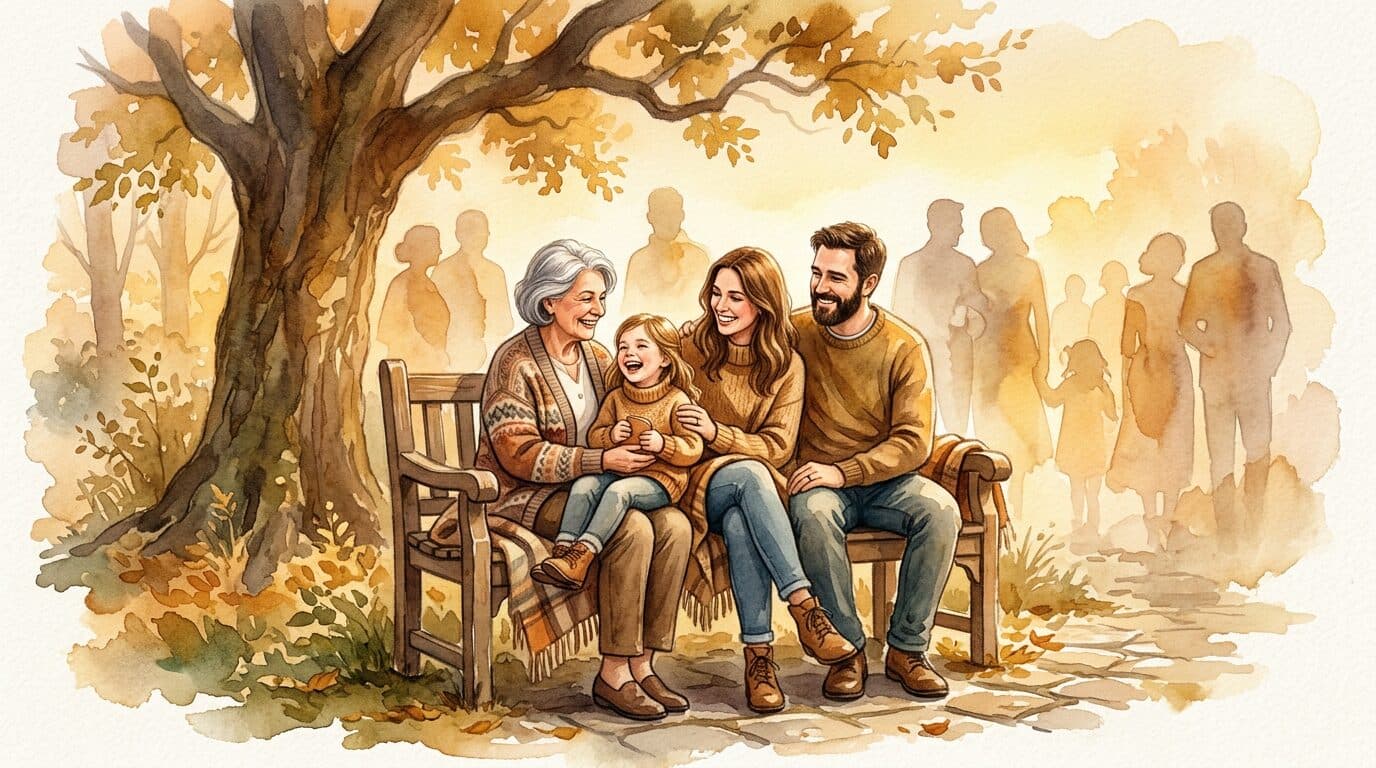
Your great-grandparents had stories. Stories about crossing oceans, surviving hardship, falling in love, building something from nothing, making choices that shaped the family you were born into. You probably know almost none of those stories. That is not unusual. It is the rule.
Researchers who study oral history and family narrative have documented a consistent pattern: without deliberate preservation, most family stories disappear within three generations. Your grandparents know their parents' stories. Your parents know some of them. You know fragments, if anything. Your children will know almost nothing.
This is not about bad memory or careless families. It is about how stories travel, and why that system breaks down.
How Stories Disappear
In most families, stories are passed along informally. Around the dinner table. On long car rides. During holidays when everyone gathers and someone says, "Did I ever tell you about the time...?" This is how every human culture has preserved its history for thousands of years. And for thousands of years, it worked, because families lived close together, spent time together daily, and had few competing demands on their attention.
Three things changed that. First, families became geographically scattered. The grandparent in Ohio, the children in California and Texas, the grandchildren everywhere. Physical distance reduced the casual, repeated storytelling that keeps memories alive.
Second, the pace of daily life accelerated. Even when families are together, the time for unhurried conversation shrinks every year. A holiday visit is three days, not three weeks. Dinner is forty-five minutes, not two hours.
Third, and most importantly, nobody thinks to ask. Children assume their parents' stories will always be available. By the time they want to hear them, the window has often narrowed or closed entirely.
The Three-Generation Pattern
The pattern typically looks like this:
Generation 1 lives the stories. They carry vivid, detailed memories of their experiences, their parents, their grandparents. They are the primary source.
Generation 2 hears the stories firsthand. They grow up listening to their parents and grandparents talk. They absorb some stories deeply and forget others. They carry an incomplete but meaningful version of the family narrative.
Generation 3 gets fragments. By now, the original storyteller may be gone or elderly. Generation 2 retells some stories but not all, and the details shift with each retelling. Names get fuzzy. Dates become approximate. The emotional context fades.
Generation 4 inherits almost nothing. The stories that defined a family's identity, the immigration story, the Depression-era resilience, the unlikely romance, the tragedy that was overcome, are effectively gone. Not because nobody cared, but because nobody recorded them.
What Gets Lost Is Not What You Expect
When people think about losing family stories, they think about the big events. The war. The cross-country move. The business that failed or succeeded. And those do get lost. But the most painful losses are smaller and more personal.
What your grandmother's kitchen smelled like on Sunday mornings. The nickname your grandfather had for your mother when she was small. The argument that almost ended a marriage and the reconciliation that saved it. The reason your family celebrates a particular holiday in a particular way. The inside joke that made everyone laugh for thirty years.
These details are not recorded in any document. They live only in the memories of the people who experienced them. When those people are gone, the details go with them.
The Urgency Is Real, But Not Hopeless
If you are reading this and feeling a pang of recognition, that feeling is telling you something important. Not guilt. Not panic. Just awareness. The stories are still available right now, in the minds of the people who lived them. That will not always be true.
The good news is that breaking the three-generation cycle requires only one thing: someone who decides to record. Not a professional historian. Not a published author. Just someone who cares enough to ask the questions and preserve the answers.
The research on why telling your life story matters shows that the act of recording benefits everyone involved. The storyteller gains clarity, perspective, and the satisfaction of being heard. The listener gains context for their own identity. And the family gains a permanent record that outlives any single memory.
What Recording Actually Looks Like
Preserving family stories does not require a formal project, a recording studio, or even a plan. It can start with a single conversation. A Sunday afternoon phone call where you ask your mother about her childhood. A holiday dinner where you ask your father about his first job. A quiet moment with a grandparent where you say, "Tell me about when you were my age."
The key is capturing it. A conversation that is not recorded is just another conversation. It lives in your memory for a while and then fades, exactly like the stories you are trying to save.
If you want a structured approach, our guide on recording your parents' stories covers the practical steps. And if you are not sure where to start the conversation, our collection of questions to ask elderly parents gives you dozens of starting points that go beyond the surface.
You Are the One Who Breaks the Pattern
In every family, there is eventually someone who looks back and realizes what has been lost. The question is whether that realization comes too late. If you are reading this, it has not come too late for you. The people whose stories matter to your family are still here. Their memories are still intact, or intact enough. The window is open.
You do not need to record everything. You do not need to be comprehensive or perfect. Even a handful of stories, told in someone's own voice and preserved in their own words, is infinitely more than what most families have after three generations: nothing.
Journtell makes this simple. Your family member speaks their memories, and their Story Team (five specialized roles working together) transforms each one into a polished, readable story that still sounds like them. No writing required. No technology skills needed. Just a willingness to remember, out loud, for the people who come next.
The three-generation clock is always running. But it only takes one person, in one generation, to stop it. Start preserving your family's stories today.
Ready to write your life story?
Journtell makes memoir writing effortless. Just speak or type your memories, and your Story Team turns them into a beautifully written book.
Start Writing Free