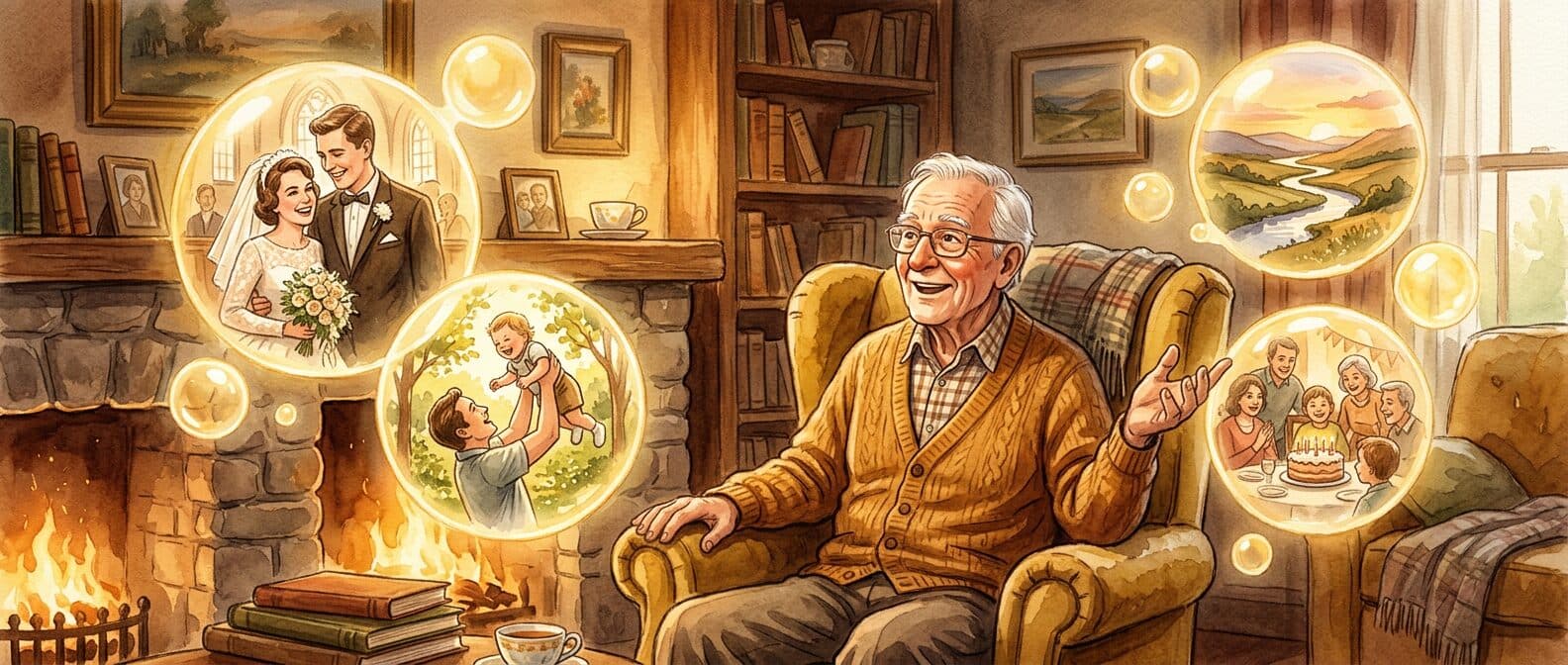
Telling your life story feels like a sentimental exercise. Something you do for the grandchildren, or because someone gave you a journal for Christmas. But behind the sentimentality is a body of research spanning decades, across psychology, neuroscience, and gerontology, that points to something more profound. Telling your story is not just nice. It is measurably good for you.
What Is Reminiscence Therapy?
In clinical settings, the structured practice of recalling and sharing life memories is called reminiscence therapy. Developed in the 1960s by psychiatrist Robert Butler, it was originally used to help older adults find meaning and continuity in their lives. Since then, it has become one of the most widely studied non-pharmacological interventions in elder care.
Reminiscence therapy takes many forms: one-on-one conversations, group storytelling sessions, life review journals, and memory books. What they all share is a simple premise. When people are given the space and encouragement to tell their stories, good things happen.
A 2018 meta-analysis published in Aging & Mental Health reviewed 128 studies and found consistent positive effects on depression, wellbeing, self-esteem, and life satisfaction among older adults engaged in reminiscence activities. The effects were not trivial. For depression in particular, structured reminiscence programs performed comparably to many standard interventions.
How Storytelling Strengthens Memory
One of the most counterintuitive findings in memory research is that the act of recalling a memory actually changes it. Every time you retrieve a memory, you reconstruct it. You fill in gaps, correct details, and reconnect it to the broader narrative of your life. Far from being a passive playback, remembering is an active, creative process.
This is why telling stories protects memory rather than merely recording it. When you tell the story of your first day at work, you are not just retrieving a file. You are strengthening the neural pathways that hold it, adding context, linking it to related memories, and making it more resistant to fading.
Research from the University of Cambridge has shown that older adults who regularly engage in autobiographical storytelling show better episodic memory performance than those who do not. The stories themselves become anchors, holding clusters of related memories in place.
Emotional Wellbeing and Sense of Purpose
The psychological benefits of life storytelling go beyond memory. When people review their lives and shape them into coherent narratives, they gain a stronger sense of identity and purpose. Psychologist Erik Erikson called this "ego integrity," the feeling that your life has made sense, that it has been meaningful even with its hardships and mistakes.
Studies consistently show that older adults who engage in life review report:
- Higher self-esteem and self-worth
- Reduced symptoms of depression and anxiety
- A greater sense of control and autonomy
- Improved social connection and reduced loneliness
Importantly, the benefits are not limited to people with clinical depression or cognitive decline. Healthy older adults also show measurable improvements in life satisfaction after structured storytelling activities. Telling your story is not a remedy for illness. It is a practice that enriches an already good life.
The Family Connection
Perhaps the most striking research comes from Emory University, where psychologists Marshall Duke and Robyn Fivush developed the "Do You Know?" scale. They asked children twenty questions about their family history: "Do you know where your grandparents grew up?", "Do you know how your parents met?", and so on.
The results were remarkable. Children who knew more about their family history showed higher self-esteem, a stronger sense of control over their lives, lower levels of anxiety, and greater resilience in the face of stress. Knowing where you come from, it turns out, helps you navigate where you are going.
The implication for life storytelling is direct. When a grandparent shares their stories, they are not just preserving history. They are giving their grandchildren a psychological resource, a narrative foundation that supports identity, confidence, and emotional strength.
This is one of the reasons helping your parents preserve their stories matters so much. If you have been thinking about how to start that conversation, our guide on helping your parents write their life story covers the practical side in detail.
The Storyteller's Bonus
There is a well-documented phenomenon in psychology called the "writing cure" or "expressive writing effect." Pioneered by James Pennebaker at the University of Texas, the research shows that writing or speaking about significant life events improves both mental and physical health. Participants who wrote about meaningful experiences for just fifteen to twenty minutes showed reduced stress, improved immune function, and better emotional processing.
The mechanism is thought to be narrative construction. When you take a swirl of emotions, memories, and impressions and shape them into a story with a beginning, middle, and end, you gain a sense of mastery over those experiences. Events that felt chaotic become comprehensible. Painful memories become stories you survived.
This does not mean life storytelling is a substitute for professional support when it is needed. But it does suggest that the everyday act of shaping your experiences into stories has genuine, measurable benefits for the person doing the telling.
You Do Not Need a Clinician
The beauty of this research is that you do not need a therapist, a clinical setting, or a formal program to benefit from life storytelling. The effects show up in informal settings too: a conversation with a grandchild, a voice recording shared with a friend, a memory written down in a journal.
What matters is the act of telling. Turning internal memories into external stories. Giving them shape, sharing them, and in doing so, understanding your own life a little better.
Journtell was designed around exactly this principle. You share a memory by speaking or typing, and your Story Team shapes it into a story that preserves your voice and meaning. The process itself, the act of remembering and telling, is where the benefit begins. The finished book is the bonus. For a practical guide on how to get started, see our article on recording your parents' stories.
Start Telling Your Story
The science is clear. Telling your life story strengthens memory, improves emotional wellbeing, builds family resilience, and helps you make sense of the life you have lived. And you do not need special training, equipment, or writing ability to begin. You just need to start sharing. Start your life story with Journtell today.
Ready to write your life story?
Journtell makes memoir writing effortless. Just speak or type your memories, and your Story Team turns them into a beautifully written book.
Start Writing Free