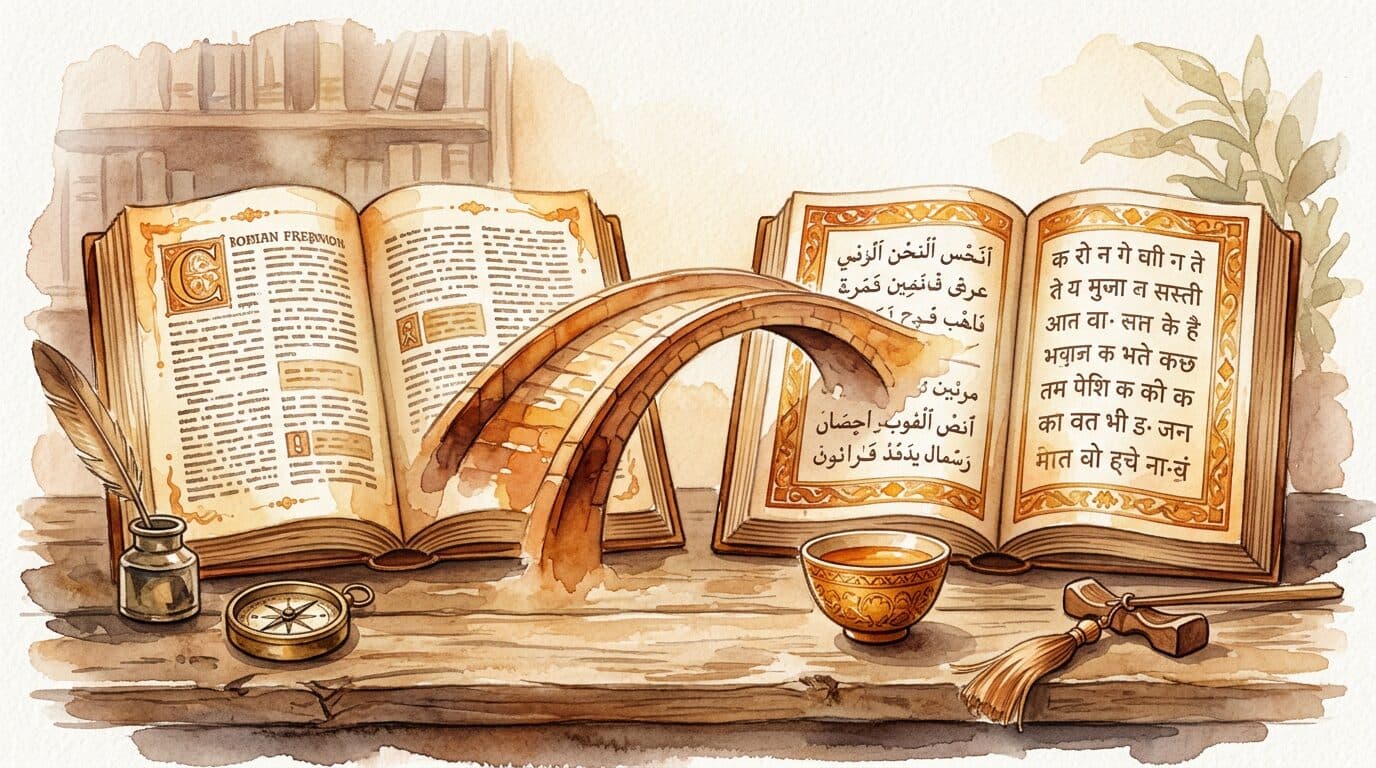
When your mother scolds you, she uses your birth language. When she tells you she is proud of you, she might use either. When she describes the village she came from, the words that surface are the ones she learned there, not the ones she learned here. Language is not just a tool for communication. It is a container for memory, and some memories only fit in the language they were formed in.
If your family spans two languages, writing a life story means navigating between them. This is not a problem to solve. It is a richness to preserve.
Why Some Memories Belong in the Original Language
Researchers who study bilingual memory have found something consistent: emotional memories are most vivid in the language in which they were experienced. A lullaby your grandmother sang in Portuguese. The phrase your father used when he was angry, the one that had no real English translation. The word for the food your mother made that means more than the English word for the same dish ever could.
These linguistic artifacts are not decoration. They are the story. When your grandmother describes her wedding in the language it happened in, the cadence, the expressions, the humor all come through naturally. Translated into English, the same story is accurate but flattened, like a photograph of a painting.
A bilingual life story preserves both the translation and the original. It keeps the Portuguese lullaby alongside its English meaning. It uses the Spanish nickname and then explains it. It lets the storyteller move between languages the way they actually think and speak, because that movement is itself part of the story of their life.
Common Challenges
The storyteller is more comfortable in one language. Your grandmother might be fluent in English for daily life but reach for her birth language when talking about childhood. This is natural. The memories from before immigration are stored in the language of that time. Let her speak in whatever language the memory arrives in.
The audience speaks only one language. If your grandchildren speak only English, a story told entirely in Korean is inaccessible to them. But a story told in English with Korean phrases, names, and expressions woven in is accessible and richer for the weaving. The untranslated words become teaching moments, cultural anchors that connect the reader to a world they never knew.
Translation flattens meaning. Some words and phrases simply do not translate. The Japanese concept of mono no aware (the gentle sadness of passing things), the Filipino bayanihan (communal unity in times of need), the Yiddish kvell (to burst with pride over someone else's accomplishment): these words carry cultural meaning that no English equivalent can match. In a bilingual life story, you keep them, explain them, and let them do their work.
The storyteller code-switches. Many bilingual people naturally switch between languages within a single thought, sometimes within a single sentence. This is not confusion. It is fluency. A life story that preserves code-switching captures how the person actually thinks, which is one of the most authentic things a memoir can do.
How to Approach It
Let the storyteller speak naturally. Do not ask them to pick a language. Let them tell their stories the way they would tell them in conversation: switching, mixing, reaching for the word that fits, regardless of which language it comes from. The authenticity of their voice is more important than linguistic consistency.
Include key phrases in the original language. When a word or phrase carries meaning beyond its translation, include both. "My mother would say 'ya veremos' whenever we asked for something, which roughly means 'we will see,' but really means 'probably not.'" The original phrase, the translation, and the real meaning together create a complete picture.
Explain cultural context. If a story references a tradition, a custom, or a social norm that the reader might not understand, a brief explanation preserves the story's meaning across cultural boundaries. "In our village, the eldest daughter always served the tea. This was not about servitude. It was about honor."
Preserve names and terms of endearment. What your grandmother called you, the name for the bread your family baked, the word for the game you played in the street: these specifics are the texture of the story. They are also the words that future generations will recognize as "ours," the linguistic heritage of the family.
The Immigration Story
For immigrant families, the story of coming to a new country is often the most important story in the family archive, and the one most at risk of being lost. The first generation lives it. The second generation hears it, sometimes. The third generation inherits almost nothing.
The immigration story is inherently bilingual. It begins in one language and one country, passes through a period of dislocation and adaptation, and arrives in a new language and a new identity. A life story that captures this journey in both languages preserves not just the events but the felt experience of becoming someone new while remaining who you always were.
If you are helping an immigrant parent or grandparent record their stories, our guide on recording your parents' stories covers practical techniques. And our collection of questions to ask elderly parents includes prompts that draw out the stories of origin, arrival, and transformation.
What Gets Preserved
A bilingual life story preserves something that a monolingual version cannot: the sound of the family. The way your grandmother mixed languages when she was excited. The words your father used that you always thought were English until you realized they were not. The prayer in the old language that nobody in the family can fully translate but everyone knows by heart.
These linguistic details are part of the family's DNA. They connect the grandchild born in Houston to the great-grandmother born in Oaxaca. They make the family story continuous rather than fragmented. They say: we came from there, and we brought this with us.
With Journtell, you speak your memories in whatever language comes naturally. Your Story Team (five specialized roles working together) preserves your voice across languages, keeping the original phrases that carry cultural weight while ensuring the overall story is accessible to English-speaking family members. No translation required. No choosing one language over the other. Just your voice, your words, your story.
For more on why preserving these stories matters, our piece on why families lose their stories in three generations explains the urgency. And if you are ready to start, your story is waiting in whatever language it wants to be told in. Begin today.
Ready to write your life story?
Journtell makes memoir writing effortless. Just speak or type your memories, and your Story Team turns them into a beautifully written book.
Start Writing Free