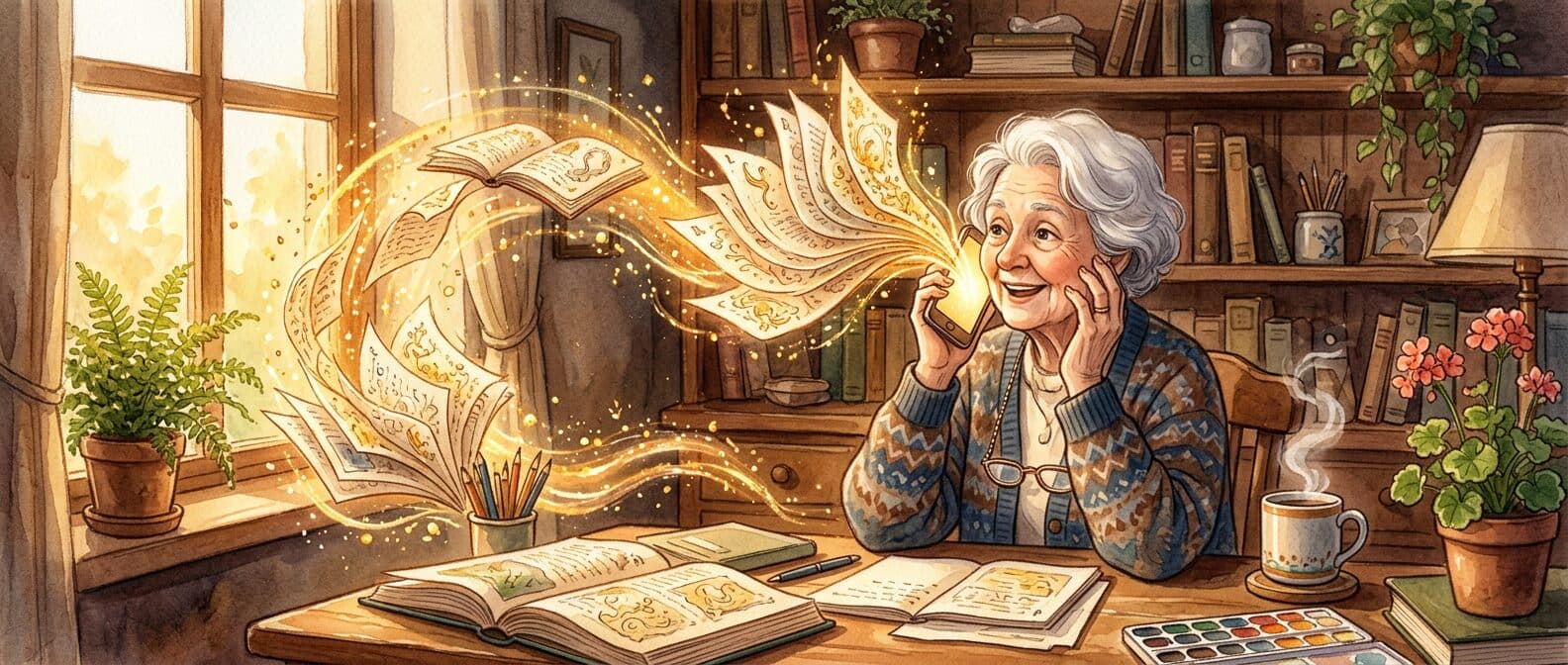
You have stories worth telling. Decades of them. The problem has never been a lack of material. It has been the tools. Blank pages, blinking cursors, the nagging feeling that you are not a "proper writer." But something has changed. The tools have finally caught up with the storyteller, and they no longer ask you to type a single word.
The Old Way Was Hard for a Reason
For most of history, writing a life story meant sitting down with a pen or a typewriter and doing it all yourself. You had to remember, write, edit, organise, and somehow make it read well. That is a lot of separate skills rolled into one task. Most people gave up before they finished the first chapter, not because they had nothing to say, but because the process was exhausting.
Journals helped, but they tend to capture fragments rather than stories. Tape recorders captured the voice but left you with hours of audio and no clear path to a finished book. Ghostwriters worked brilliantly if you could afford one. For everyone else, the life story stayed in their head.
Voice-First Writing: Just Talk
The single biggest shift in memoir writing is this: you no longer need to write at all. You can speak. Modern voice-first tools let you record a memory the same way you would tell it to a friend over tea. No structure required, no grammar anxiety, no blank page staring back at you.
This matters more than it sounds. When people speak their memories, they are more natural, more vivid, and more emotionally honest than when they write. The story about your first job, told aloud, will have details and warmth that a written version often flattens. Speaking unlocks memory in a way that writing rarely does.
With Journtell, you simply open the app and start talking. Five minutes of a spoken memory becomes a polished, readable story. You do not need to think about paragraphs or punctuation. You just need to remember.
Smart Follow-Up Questions
One of the hardest parts of writing a memoir is knowing what to include. When you have lived through something, you often skip the very details that make the story come alive. You forget to mention the weather, the look on someone's face, the thing they said that changed everything.
This is where Journtell's Interviewer comes in. After you share a memory, the Interviewer asks thoughtful follow-up questions. Not generic prompts, but questions tailored to what you just said. "You mentioned your father's workshop. What did it smell like?" or "You said that conversation changed everything. What happened the next morning?" These questions draw out the texture that turns a memory into a story.
It is the difference between "I got married in 1972" and the rich, layered account of the day that your grandchildren will want to read.
Preserving Your Voice
One worry people have is that their stories will come back sounding like someone else wrote them. Formal, stiff, generic. That is a reasonable fear. Nobody wants their life story to read like a textbook.
Journtell's Story Team includes a role called the Voice, whose entire purpose is to keep your stories sounding like you. If you use dry humor, it stays dry. If you tend to understate things, the understatement is preserved. If you have favorite phrases or a particular rhythm to how you speak, the Voice notices and keeps those patterns intact.
The result is a polished story that reads well on the page but still feels unmistakably yours. Your family will hear you in every sentence.
From Scattered Memories to a Book
Even if you record dozens of wonderful stories, turning them into a coherent book is its own challenge. What order should they go in? Are there gaps? How do you weave thirty separate memories into something that flows?
This is where a Story Map helps. As you add memories, Journtell organizes them across the themes and periods of your life. You can see at a glance which chapters are rich with stories and which have gaps worth filling. Over time, a shape emerges: not just a collection of anecdotes, but a genuine life story with arc, depth, and meaning.
When you are ready, your collected stories become a beautifully formatted book, ready to print, share, or pass down. If you would like a complete walkthrough of the process, our guide on how to write your life story covers every step.
Who Is This For?
You do not need to be a writer. You do not need to be comfortable with technology. You do not need to have led an extraordinary life. If you can have a conversation, you can create a life story book.
These tools are especially valuable for people who have always wanted to preserve their memories but felt the process was too difficult, too time-consuming, or too intimidating. The barrier is gone. All that remains is you and your stories.
If the idea of writing still feels daunting, you are not alone. Our article on writing your life story with no writing experience was written for exactly that feeling.
Start for Free
Your memories deserve more than a shoebox of photographs and a few anecdotes that get shorter with every retelling. They deserve to be captured properly, shaped into stories, and collected into something your family will treasure for generations. Journtell makes the entire process as simple as having a conversation. Start preserving your life story today.
Ready to write your life story?
Journtell makes memoir writing effortless. Just speak or type your memories, and your Story Team turns them into a beautifully written book.
Start Writing Free