When someone you love begins losing their memory, the grief starts long before they are gone. It starts with the repeated question, the forgotten name, the story that trails off mid-sentence. And somewhere in that slow unraveling, a quiet urgency takes hold: the stories. Their stories. The ones only they can tell. The ones that will disappear with their memory if nobody captures them first.
If you are in this situation, this guide is for you. It is not about diagnosis or treatment. It is about something simpler and more urgent: how to preserve the stories of someone whose ability to tell them is changing.
Start Now, Not Later
The single most important piece of advice is this: do not wait. Memory loss is progressive. The stories available today may not be available next month. The details that are vivid now will blur. The names and places that come easily today will become harder to retrieve.
This does not mean you need to rush. It means you need to begin. One conversation this week is worth more than a perfect plan that starts next month.
If you are feeling overwhelmed about where to start, remember that any story is better than no story. You are not trying to capture everything. You are trying to capture something, before the window closes further.
Keep Sessions Short and Warm
Long interviews are exhausting for anyone, and they are especially draining for someone with memory difficulties. Twenty minutes is often the ideal length. Thirty minutes is the maximum for most people. Beyond that, fatigue sets in and the experience becomes stressful rather than enjoyable.
Choose the time of day when they are most alert and comfortable. For many people with memory loss, mornings are clearest. Afternoons can bring confusion or fatigue. You know your person best, so pay attention to their rhythms and schedule accordingly.
The physical environment matters too. Sit somewhere familiar, quiet, and comfortable. Minimize distractions. Turn off the television. Make it feel like a conversation, not an examination.
Use Familiar Anchors
Abstract questions ("Tell me about your childhood") are hard for anyone to answer. For someone with memory loss, they can be paralyzing. Instead, anchor your questions to something concrete and sensory.
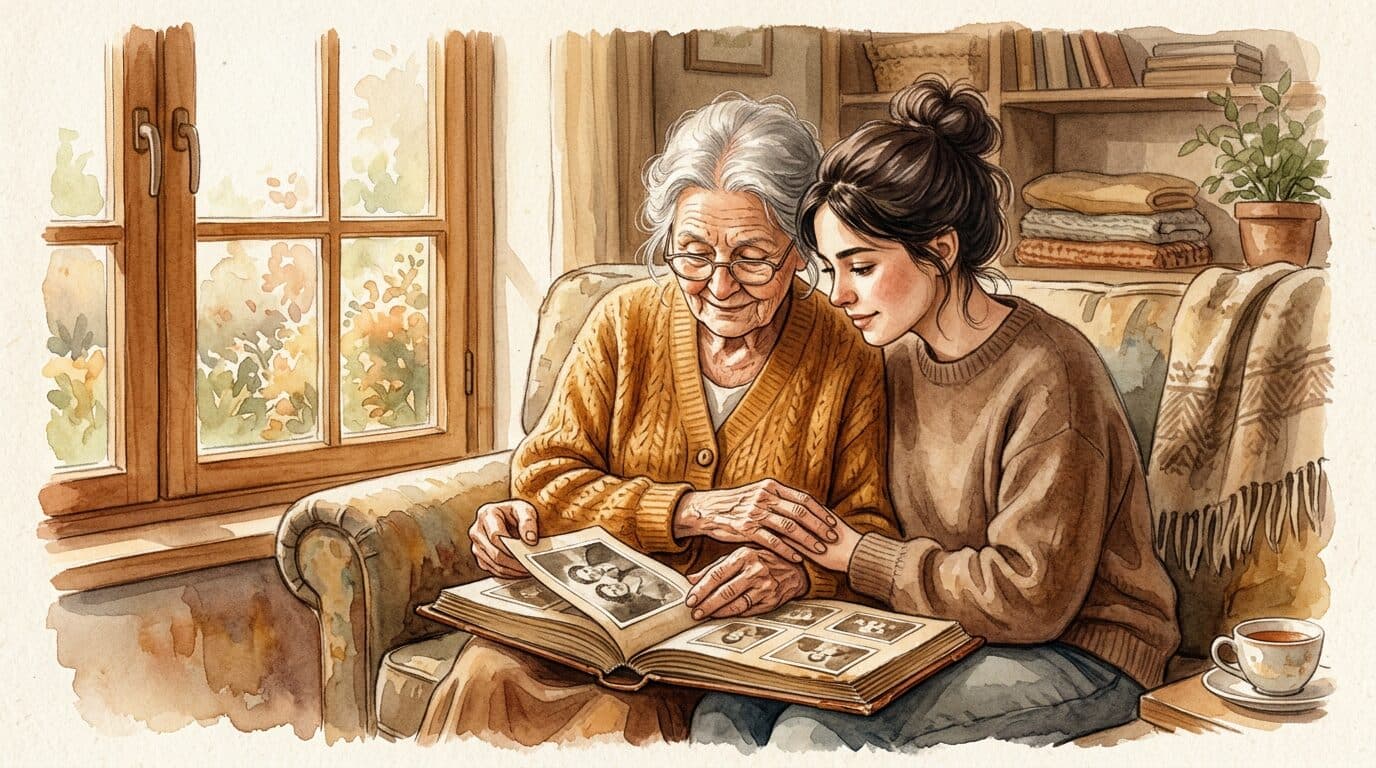
Old photographs are the single most effective memory trigger. A photograph from the 1960s can unlock stories that a direct question cannot reach. Hold up a photo and ask: "Who is this? Where was this taken? What do you remember about that day?" The visual cue gives the brain a foothold.
Other anchors that work well:
Familiar objects: a piece of jewelry, a tool, a cookbook, a piece of furniture that has been in the family for decades. "Tell me about this ring. Who gave it to you?"
Music: songs from their era can unlock memories with remarkable reliability. Play a song they loved and ask what it reminds them of.
Food: the smell or taste of a familiar dish can trigger vivid recall. Cook something they used to make and ask them about the recipe, where they learned it, who they cooked it for.
Places: if you can visit a place that was important to them (their old neighborhood, a church, a park), the physical space can bring stories to the surface that words alone cannot.
Ask Simple, Specific Questions
Open-ended questions require the brain to organize and sequence information, which is exactly what becomes difficult with memory loss. Instead, ask questions that are specific and concrete:
Instead of "What was your childhood like?" try "What did your mother cook for dinner?"
Instead of "Tell me about your career" try "What was your first boss's name?"
Instead of "How did you meet Dad?" try "Where were you the first time you saw Dad?"
These small, focused questions are easier to answer, and each answer often leads naturally to the next story. Let them follow wherever the memory takes them, even if it wanders. Wandering memories are still memories.
Do Not Correct or Quiz
This is perhaps the hardest part. When they get a date wrong, or mix up which child did what, or tell a story you know happened differently, let it go. You are not here to fact-check. You are here to listen.
Correcting someone with memory loss does not improve accuracy. It creates frustration and self-consciousness, which makes them less willing to share. The emotional truth of a story matters more than the factual precision. If your mother says she married your father in 1962 when it was actually 1964, the story of how they fell in love is still the story. The year is a detail. The love is the point.
Similarly, do not test their memory by asking questions you already know the answer to. "Do you remember what year we moved to the new house?" feels like an exam. "Tell me about the house on Maple Street" feels like an invitation.
Involve Other Family Members
You do not have to do this alone. In fact, involving multiple family members can enrich the process. Different people trigger different memories. Your mother might tell your brother stories she never tells you, simply because his questions lead somewhere different.
Coordinate gently. Let family members know you are working on preserving stories and invite them to have their own conversations. Share what you have learned so far so nobody asks the same questions repeatedly. And share the results, because seeing their stories written down often motivates the storyteller to share more.
If you are looking for specific questions that draw out real stories rather than surface-level facts, our guide on the best questions to ask elderly parents is designed for exactly this kind of conversation.
Record, Do Not Rely on Memory
This applies to your memory too. After a conversation with someone whose memory is fading, you might think you will remember what they said. You will not, at least not with the specificity that makes a story come alive. Record the conversations. A phone's voice recorder is enough. Or use a platform like Journtell, where spoken memories are automatically shaped into polished stories by a Story Team of five specialized roles working together, while preserving the storyteller's own voice and way of speaking.
The advantage of recording is that you capture not just the words, but the pauses, the laughter, the way they say a name, the tone that tells you this memory matters. These are the things that disappear first when you try to reconstruct a conversation from your own notes.
Accept Imperfection
The stories you capture will be incomplete. Some will have gaps. Some will contradict other versions you have heard. Some will be fragments: a name, an image, an emotion without a clear narrative attached. That is all fine. A fragment is infinitely more than nothing.
Do not wait for the perfect session, the perfect question, or the perfect day. Memory loss does not pause for your preparation. The best recording is the one you actually make, even if it is messy, even if it is short, even if it catches only a single story in twenty minutes.
It Is an Act of Love
What you are doing, sitting with someone whose memory is fading and asking them to tell you one more story, is one of the most loving things a family member can do. You are saying: your experiences matter. Your life was important. The things you remember are worth keeping.
For many people with memory loss, being asked about their past is one of the few experiences that still feels fully like themselves. Their long-term memories are often the last to fade, and talking about them can bring a clarity and joy that the present moment no longer provides.
For practical guidance on structuring these conversations, our guide on interviewing your parents about their life offers a compassionate, step-by-step approach. And our tips on recording your parents' stories cover the logistics of capturing everything.
The window is open right now. It may be smaller than it was last year, and it will be smaller next year. But it is open. Journtell can help you make the most of it. Your loved one speaks their memories, and their Story Team preserves every story in their own voice, creating a book that your family will hold onto long after the memories themselves have faded. Start preserving their stories today.
Ready to write your life story?
Journtell makes memoir writing effortless. Just speak or type your memories, and your Story Team turns them into a beautifully written book.
Start Writing Free