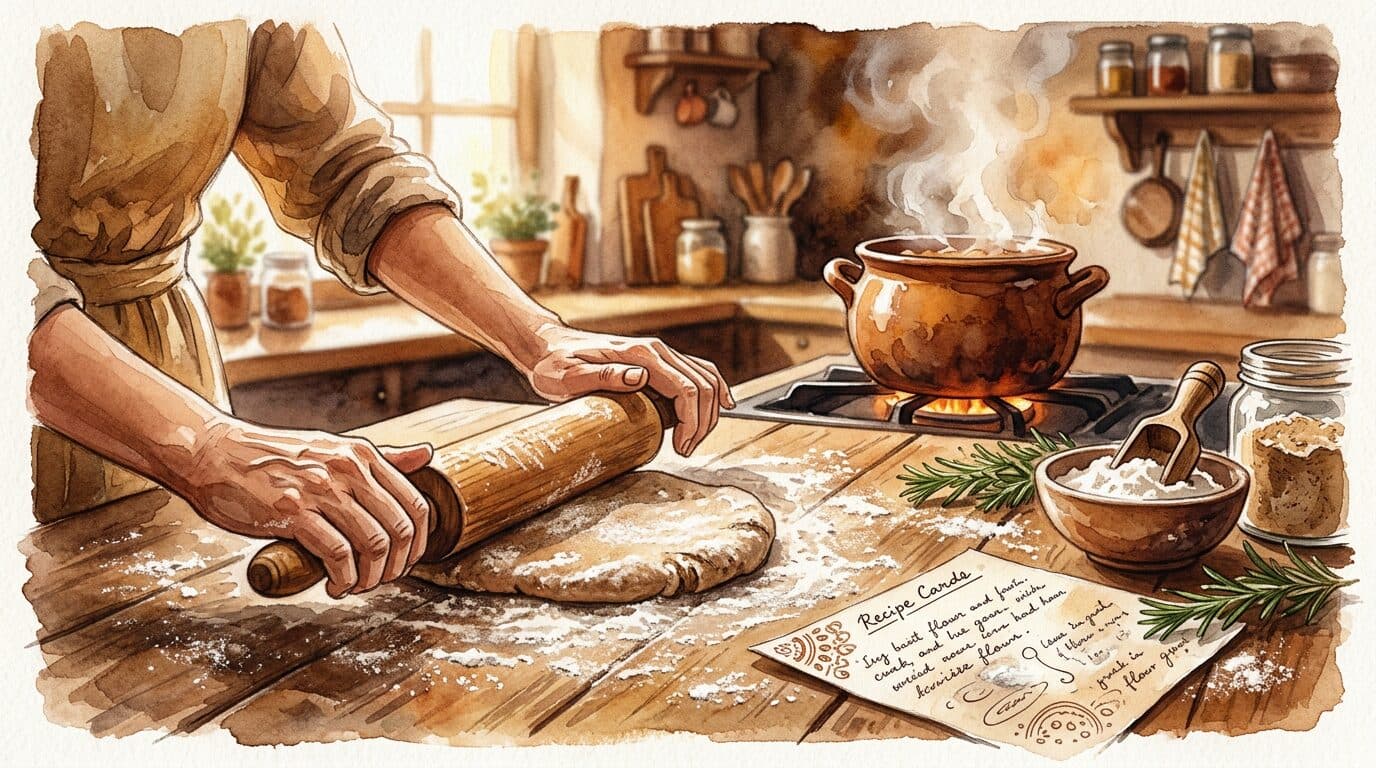
Your grandmother's soup. You know the one. The recipe has been in the family for generations, except it has never actually been written down. "A little of this, a pinch of that, you will know when it is right." And somehow, improbably, it is always right when she makes it, and never quite right when anyone else tries.
The recipe is not really the recipe. The recipe is everything around it: who taught her, where she learned it, what it meant to her family, why she makes it on that particular day, and what happens in the kitchen while she cooks. Those stories are the real inheritance, and they are more fragile than any ingredient list.
What Gets Lost When a Recipe Loses Its Story
Families preserve recipes all the time. They write them on index cards, tape them inside cabinet doors, text them to siblings. The ingredients and the steps survive. But the story rarely does.
Without the story, your grandmother's soup becomes a recipe anyone could have made. The fact that she learned it from her own grandmother during the winter they lived in a one-room apartment. The fact that it was the only thing that tasted like home when they moved to a new city. The fact that she added a secret ingredient (a bay leaf, or a spoonful of vinegar, or something she refused to name) that nobody else in the family has ever been able to identify. All of that vanishes.
And with it vanishes the reason the recipe matters. Nobody makes your grandmother's soup because it is the best soup recipe in the world. They make it because it tastes like her. The story is what makes the food meaningful, and the food is what makes the story sensory and alive.
How to Capture the Story Behind a Dish
The next time you are in the kitchen with someone who cooks a family recipe, ask these questions while they cook:
"Where did you learn to make this?" This question almost always opens a door. The answer is never just "from a cookbook." It is "from my mother, in the kitchen of our house on Third Street, when I was twelve and she was trying to teach me to be useful."
"Who do you make this for?" Food is social. The answer reveals relationships: "I make this when the grandchildren visit." "I made this every Sunday for forty years of marriage." "I make this when someone in the family is sad, because it is the thing that fixes everything."
"What do you remember about the first time you made it yourself?" First attempts are always stories. The disaster. The triumph. The phone call to your mother: "How much is a pinch?"
"Is there a secret to it?" Every family cook believes they have a secret. Sometimes it is a real technique. Sometimes it is imaginary. Either way, the answer is a story.
"What would happen if this recipe disappeared?" This question surfaces the emotional weight of the dish. The answer is usually something like "It would feel like losing a part of her," which is exactly why you are preserving it.
Recording While Cooking
The best time to record a recipe story is while the person is actually cooking. Something about the physical activity of chopping, stirring, and tasting unlocks memories that sitting at a table does not. The kitchen is the original storytelling venue for families, and being in it activates stories that might not surface anywhere else.
Let them cook. Do not interrupt the flow to make them repeat measurements. If they say "about this much" and hold up a cupped hand, note that. The imprecision is part of the recipe. Your grandmother's hand is the measuring cup, and that fact is worth recording.
If you are recording on a phone, set it down on the counter and let it run. The ambient sounds of cooking (the sizzle, the clatter, the timer) add texture to the recording and trigger additional memories.
Beyond the Kitchen
Family recipes connect to stories far beyond food:
Immigration stories. Recipes travel with families across borders. The dish that tasted like the old country. The ingredient that could not be found in the new city and had to be substituted. The way a recipe changed with geography but kept its soul.
Holiday traditions. Why this dish is made on this day. The year it was dropped on the floor and everyone ate it anyway. The argument over whether it should include raisins. Holiday food stories are among the funniest and most beloved in any family archive.
Love stories. The meal she made him on their first date. The dish he learned to cook to impress her. The recipe that was a peace offering after a fight.
Survival stories. What you cooked when money was tight. The meals that got the family through the hard years. "We ate oatmeal for dinner and my mother called it a banquet." These stories of resourcefulness and love are powerful precisely because they are about something as basic as feeding a family.
Preserving the Full Picture
A complete recipe preservation includes three things: the ingredients and steps (written down or recorded), the story behind the dish (who, where, when, why), and ideally, a photograph or description of what it looks like when it is done right. Together, these give future family members everything they need to recreate not just the food, but the experience of making it.
For more ways to draw out family stories through sensory memory, our guide on recording your parents' stories covers techniques that work especially well around food, places, and objects. And for a broader collection of family interview questions, our guide on questions to ask elderly parents includes food and tradition prompts.
With Journtell, your family cook can simply talk about their recipes while cooking, and their Story Team shapes each memory into a story that preserves not just the measurements, but the meaning. Every dish becomes a chapter in the family story.
The recipe is just the beginning. The story is the heirloom. Start preserving yours today.
Ready to write your life story?
Journtell makes memoir writing effortless. Just speak or type your memories, and your Story Team turns them into a beautifully written book.
Start Writing Free