There is a moment, usually around a holiday table or a quiet Sunday afternoon, when it strikes you: your grandparents will not be here forever, and neither will their stories. The anecdote about the winter your grandfather walked five miles to school. The way your grandmother describes the dress she wore the night she met him. The recipes, the warnings, the jokes that only make sense if you know the backstory. All of it lives in their memory, and nowhere else.
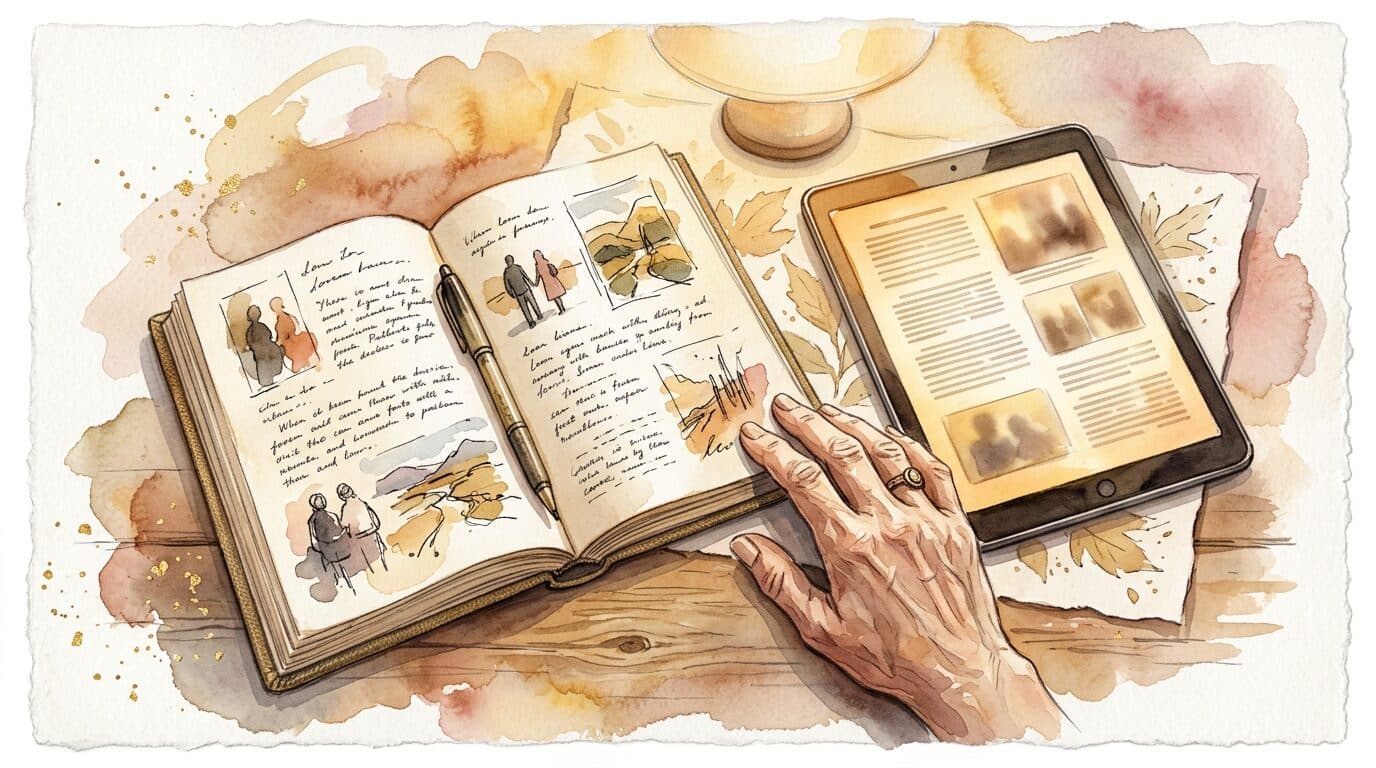
That realisation sends most people in one of two directions. Some reach for a grandparent memory book, one of those beautifully bound journals filled with prompts and blank lines, ready to be filled in by hand. Others turn to digital platforms that capture stories through voice or text and organise them into something lasting. Both approaches come from the same impulse: the urgent, loving desire to hold on to what matters before it slips away.
But they work very differently, and the choice between them is worth thinking through carefully.
What Is a Grandparent Memory Book?
A grandparent memory book is, at its simplest, a guided journal. It contains prompts and questions printed on the page, with space beneath each one for handwritten answers. Titles like Grandma, Tell Me Your Story and Grandfather, I Want to Hear Your Story have become Amazon bestsellers, and for good reason. They are lovely objects. They feel personal. They arrive gift-wrapped and say, without saying it directly, "Your life matters and I want to know about it."
The format is usually fill-in-the-blank or short-answer. "Where were you born?" "What was your favorite subject at school?" "Describe your first job." "What advice would you give your grandchildren?" The prompts are gentle and accessible, designed so that anyone can pick up the book and begin writing without feeling overwhelmed.
These books have been around for decades, but their popularity has surged in recent years. The desire to preserve family stories seems to grow stronger the faster the world changes, as though we sense that the pace of modern life is quietly erasing the slower, richer details of the past.
The Charm of Pen and Paper
There is something irreplaceable about a handwritten grandparent journal. The slight wobble of an elderly hand. The way your grandmother crosses her sevens or loops her lowercase g. The ink smudge on the page about her wedding day. These are not imperfections; they are intimacy. They carry the physical presence of the person in a way that typed text simply cannot.
Memory books also require no technology. No accounts, no passwords, no software updates, no Wi-Fi. For grandparents who are uncomfortable with computers or smartphones, a book and a pen is a relief. It is familiar. It is quiet. It does not ask to be charged or restarted.
And the finished object is beautiful. A completed grandparent memory book sits on a shelf and invites touch. You can hold it, flip through it, leave it on the coffee table. It has weight and texture. It smells like paper and time. It feels, in every sense, like something real.
These are genuine strengths, and any honest comparison must acknowledge them.
Where Memory Books Fall Short
But love for the format should not obscure its limitations, and those limitations are significant.
Short answers encourage shallow stories. The fill-in-the-blank format gives you a few lines per question. "What was your favorite childhood memory?" deserves pages, but the book offers inches. Most people compress their answers to fit the space, which means the richest, most interesting details get left out. The story of the summer at the lake becomes a single sentence: "Summers at Loch Lomond with my cousins." Beautiful, but barely a beginning.
No voice, no tone, no laughter. A written answer cannot capture the way your grandfather pauses before telling a story, or the way your grandmother laughs when she remembers something mischievous she did as a girl. Voice carries emotion that words on a page, however carefully chosen, cannot fully convey. The cadence, the accent, the warmth, the hesitation before something painful, these are part of the story too.
One copy, one location, one disaster away from gone. A memory book exists as a single physical object. It can be damaged by water, destroyed by fire, lost in a move, or simply misplaced. Families who have experienced a house fire or a flood know this grief intimately. The book cannot be duplicated without photographing every page, and even then the copy is a diminished version of the original.
Difficult to share with distant family. If your family is spread across the country, or across the world, the book can only be in one place at a time. Siblings, cousins, and grandchildren in other cities cannot read it without someone posting it or scanning it page by page. In an era when families are more geographically dispersed than ever, this is a real constraint.
Physical barriers matter. Arthritis, tremor, poor eyesight, or simply the fatigue that comes with age can make handwriting painful or illegible. Some grandparents want desperately to fill in their memory book but find the physical act of writing exhausting. The spirit is willing, but the hand is not. This is not a small problem. It affects precisely the people these books are designed for.
Limited space discourages return visits. Once a prompt has been answered, there is no room to add more. But memories do not arrive on schedule. Your grandmother might remember something crucial about her childhood six months after she filled in that page. The book has moved on. There is nowhere to put it.
What Digital Life Story Platforms Offer
Digital platforms approach the same goal from a different direction, and they solve most of the problems that memory books cannot.
Voice recording captures what writing misses. When your grandfather tells the story of meeting your grandmother, his voice carries decades of tenderness. You can hear the smile. You can hear the pause where he collects himself. A voice recording is not just a transcript; it is a performance, a presence, a piece of the person themselves. For families who have lost a grandparent, a recording of their voice is often the most treasured thing they have.
No space limits mean richer stories. A digital platform does not run out of pages. If your grandmother wants to spend forty-five minutes talking about the year she spent in Edinburgh, she can. If she wants to come back next week and add the part she forgot, she can do that too. The stories grow and deepen over time, rather than being compressed into a few lines on a page.
Searchable and organized. When you want to find the story about your grandfather's time in the navy, you do not need to flip through an entire book hoping to spot it. Digital stories can be tagged, categorised, and searched. Family members can find what they are looking for in seconds, which means the stories actually get revisited rather than sitting unread on a shelf.
Shareable with family anywhere. A digital life story can be accessed by family members across the world, simultaneously. Your cousin in Melbourne and your aunt in Cardiff can both read your grandmother's stories on the same evening, without anyone needing to post anything. For scattered families, this is transformative. It turns a private keepsake into a shared inheritance. If you are gathering family interview questions to ask over video calls, having a digital platform to capture the answers means nothing gets lost.
Backed up and safe. Digital stories are stored in the cloud, replicated across servers, and protected from the physical disasters that threaten paper. No fire, flood, or house move can destroy them. They persist as long as the platform does, and they can be exported and backed up independently.
Exportable to print. This is the point that surprises people: choosing digital does not mean giving up print. The best platforms allow you to export your collected stories as a beautifully formatted book, printed and bound. You get the safety and richness of digital capture with the tangible beauty of a physical object. It is not either/or.
The Hybrid Answer
Helping parents or grandparents write their life story does not have to mean choosing between a blank page and a screen. The best approach combines the warmth of personal storytelling with the power of modern tools.
This is exactly what Journtell was built to do. Your grandparent can record memories by voice, simply talking into their phone as naturally as they would across a kitchen table, or type them if they prefer. There are no fill-in-the-blank constraints, no page limits, no pressure to get it right the first time.
What happens next is where it becomes something more than a recording app. Journtell's Story Team, five specialized roles working together, transforms those raw memories into polished, publishable prose:
- The Voice learns your grandparent's natural way of speaking and ensures the written story sounds like them, not like a generic template.
- The Interviewer asks thoughtful follow-up questions that draw out details and depth, the kind of details a fill-in-the-blank prompt would never reach.
- The Archivist organizes stories chronologically and thematically, building a coherent narrative from scattered memories.
- The Narrator shapes each memory into a compelling, readable story with structure and flow.
- The Editor refines the prose, tightening sentences and ensuring clarity without losing the storyteller's personality.
The result is a collection of professionally crafted stories that sound like your grandparent, not like a ghostwriter. And when the collection is complete, it can be exported as a printed book, a real, holdable, shelf-worthy object that carries all the charm of a memory book with none of its limitations.
It is, in the truest sense, the best of both worlds.
So Which Is Right for Your Family?
The answer depends on the person and the situation.
A grandparent memory book is right if your grandparent loves pen and paper, enjoys the meditative act of handwriting, wants something simple and self-contained, and is comfortable with short, concise answers. It is also a wonderful gift for someone who already has their stories well organized in their mind and simply needs a structure to put them on paper. If the physical object itself is part of the meaning, a memory book delivers that beautifully.
A digital platform is right if your grandparent has stories that deserve more than a few lines, if they find it easier to talk than to write, if your family is spread across different cities or countries, or if you want the peace of mind that comes from knowing the stories are safely backed up. It is also the better choice for grandparents who struggle with handwriting, whether due to arthritis, tremor, or simply not enjoying it.
Journtell is right if you want both. The depth and safety of digital capture, the beauty of a printed book, and the added dimension of storytelling that turns raw memories into polished prose. It is particularly well suited for families who want to compare their options carefully and find a platform that does more than simply store recordings.
The only wrong answer is doing nothing. Every week that passes without capturing your grandparents' stories is a week of memories that might slip away quietly, without anyone noticing until it is too late.
Start Capturing What Matters
Whether you choose a memory book, a digital platform, or something that combines both, the important thing is to begin. Your grandparents' stories are not just their history; they are your family's inheritance. The recipes, the warnings, the love stories, the hard years, the quiet triumphs, all of it deserves to be kept safe and passed on.
If you would like to see how Journtell turns spoken memories into a lasting life story book, create a free account and try recording your first memory. It takes less than five minutes, and those five minutes might be the most important ones you spend this year.
Ready to write your life story?
Journtell makes memoir writing effortless. Just speak or type your memories, and your Story Team turns them into a beautifully written book.
Start Writing Free