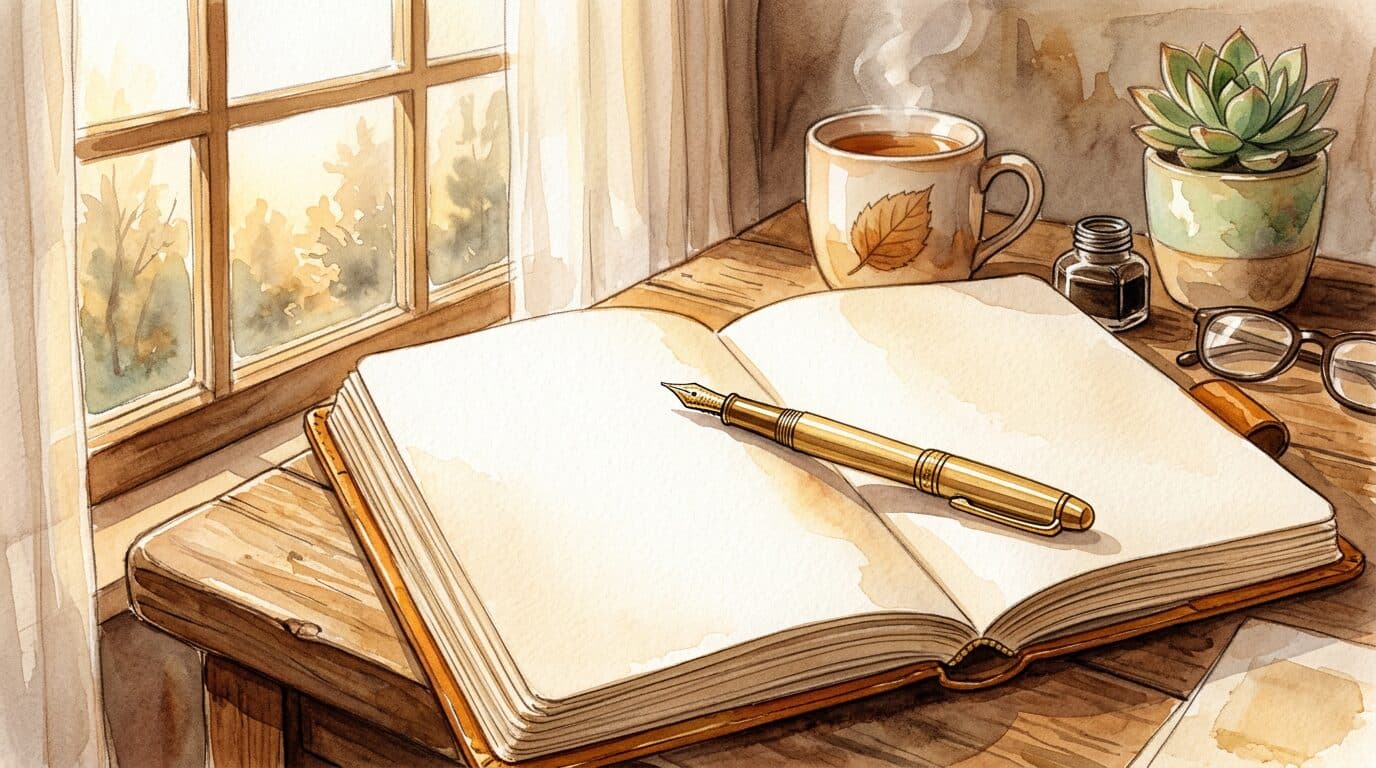
You have decided to write your life story. You have the motivation. Maybe you even have the tools. But you are sitting there, staring at a blank page or an empty recording screen, and the question is: where do I begin?
The instinct is to start at the beginning. Birth. Childhood. The earliest memory. Work your way forward. It makes logical sense. It is also the wrong move for most people, because it puts the hardest, most distant, least vivid memories first, right at the moment when your confidence is lowest and your commitment is weakest.
Here is better advice: do not start at the beginning. Start with the memory that keeps coming back.
The Memory That Keeps Coming Back
You have one. Everyone does. It is the story you have told at dinner parties. The one that surfaces in the shower, in the car, in the middle of the night. The memory that your brain keeps returning to, not because it was the most important moment of your life, but because something about it insists on being remembered.
It might be a big moment: the day you got married, the birth of your first child, the job offer that changed everything. Or it might be small: a summer afternoon when nothing happened except that everything felt right. The car ride where your father said something that stuck with you for forty years. The smell of your grandmother's kitchen.
Start there. Not because it is the best story, or the most representative, or the right place in the timeline. Start there because it is the story you can tell most easily right now. It is warmed up and ready, and you need something easy for your first entry.
Your First Entry Does Not Matter as Much as You Think
Here is a truth that will save you hours of paralysis: your first entry is not the introduction to your life story. It is not chapter one. It is not the opening that will set the tone for everything that follows. It is just the first story you happened to record.
When your life story is eventually compiled into a book, the stories will be arranged in whatever order makes the most sense. The first one you tell might end up in the middle. Or at the end. Or as a small aside in a chapter about something else entirely. Where you start recording has nothing to do with where the story begins.
This means your first entry has only one job: to exist. To prove to you that you can do this, that you have stories worth telling, and that the act of telling them is not as hard as you feared.
Just Start Talking
If you are using voice recording (and you should, if writing does not come naturally), the simplest way to begin is to just start talking. Do not plan what you are going to say. Do not write an outline. Just describe the memory as if you were telling a friend about it.
"So there was this one summer, I think I was about twelve, and my dad took me fishing at this lake up near..."
That is a perfectly fine beginning. It is informal. It is natural. It sounds like a person, not a book. And once you get three sentences in, the memory starts filling itself in. Details you forgot you remembered surface. The name of the lake. The color of the boat. What your father was wearing. The story tells itself, once you give it permission to start.
Do not worry about length. A three-minute recording is fine. A thirty-minute recording is fine. Tell as much as comes naturally, then stop. You can always come back and add more.
If You Are Truly Stuck
If no single memory is jumping out, try one of these entry points:
The house you grew up in. Close your eyes and walk through it. Describe the front door. The kitchen. Your bedroom. What did it smell like? What sounds do you remember? The physical space of your childhood is one of the most powerful memory triggers available to you.
Your first day at something. First day of school. First day at a job. First day in a new city. First days are inherently rich because they are full of uncertainty, observation, and feeling. You noticed everything because nothing was routine yet.
A meal. The best meal you ever ate. Your mother's Sunday dinner. The restaurant where you celebrated something important. Food is deeply tied to memory, and describing a meal almost always leads to the story around it.
A person. Someone who changed your life. Describe them. What did they look like? How did they talk? When did you first meet them? What did they teach you?
If you want a more comprehensive list, our 100 life story prompts organized by decade will give you more starting points than you could use in a year.
Lower the Bar
The reason most people never start their life story is not lack of interest or lack of material. It is that the bar feels impossibly high. They imagine a polished memoir, a beautiful book, a literary achievement, and the gap between that vision and "I am sitting in my kitchen talking into my phone" feels too wide.
Lower the bar. Way down. Your goal for day one is not to produce a masterpiece. It is to tell one story. Badly, if necessary. Rambly, if that is how it comes out. With false starts and corrections and "wait, no, that was not right, it was actually..." All of that is fine. All of that gets shaped later.
The only failure is not starting. Everything else is material.
What Happens After the First One
Something interesting happens after you record your first memory: you think of three more. The act of telling one story shakes loose others. The fishing trip reminds you of the summer cabin, which reminds you of the neighbor who taught you to swim, which reminds you of the first time you were genuinely afraid of water.
Memories are connected. Pull one thread and the whole web moves. Your first entry is not just a story. It is the key that unlocks dozens of others.
If you are approaching this with no writing background, our guide on writing your life story with no experience covers everything you need to know about the mindset and the process. And for the full picture of how to go from first memory to finished book, our complete guide to writing your life story walks you through every step.
With Journtell, starting is as simple as speaking. Tell one memory, and your Story Team (five specialized roles working together) will shape it into a polished story that sounds like you. Then tell another. And another. Before you know it, you have a book. But first, you just need to start. Tell your first story today.
Ready to write your life story?
Journtell makes memoir writing effortless. Just speak or type your memories, and your Story Team turns them into a beautifully written book.
Start Writing Free