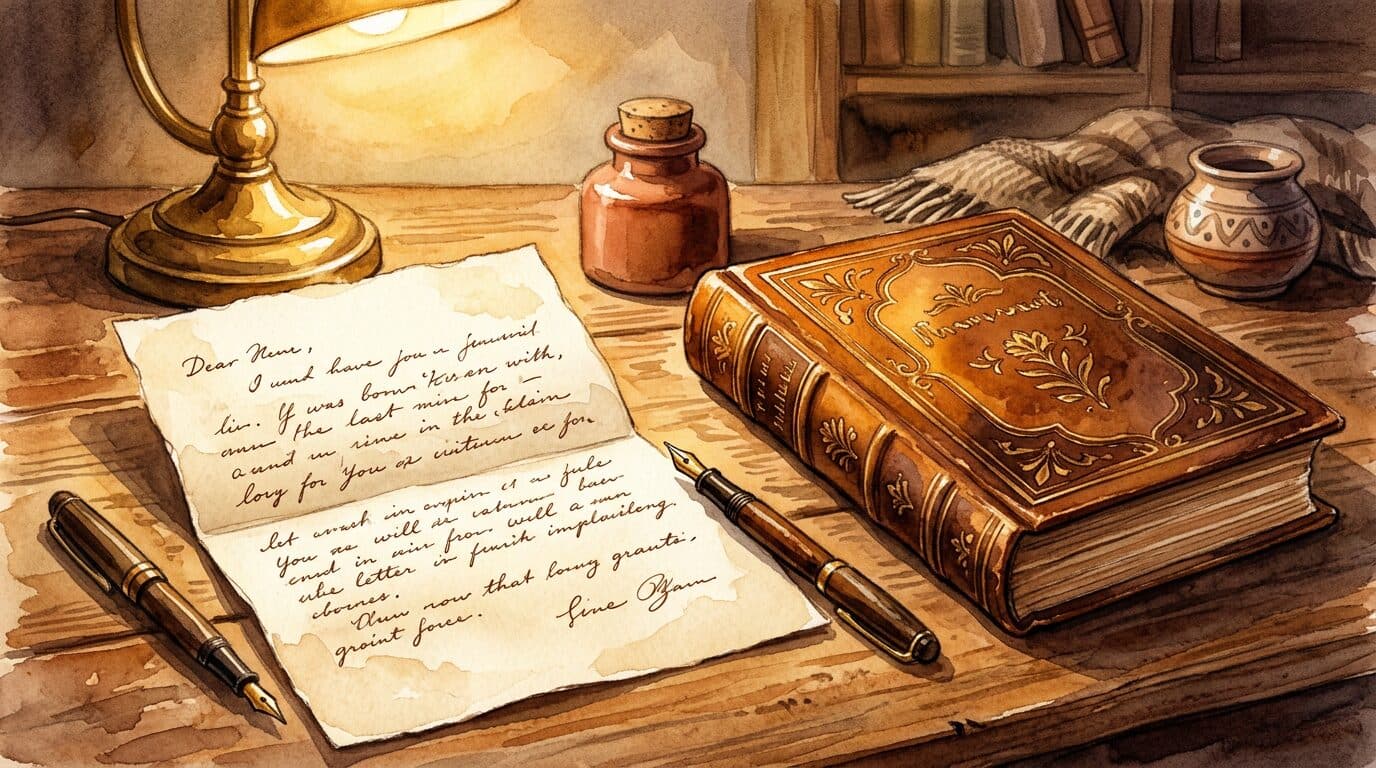
You have sorted the legal will. The house, the savings, the pension, the possessions. Everything has been accounted for. But there is a nagging thought that will not go away: what about the things money cannot pass on? The lessons you learned the hard way. The values you tried to live by. The stories that explain who you are and why you made the choices you made. Those do not fit in a solicitor's office.
This is the space that ethical wills were created to fill. And it is the space where a life story book does something even richer.
What Is an Ethical Will?
An ethical will (sometimes called a legacy letter) is a document that passes on your values, beliefs, life lessons, and hopes for future generations. Unlike a legal will, it has no binding power. It is personal, not financial. It says what mattered to you, not what belongs to whom.
The concept has ancient roots. Jewish tradition traces ethical wills back to the biblical patriarchs, with written examples surviving from the Middle Ages. But you do not need any particular faith or tradition to write one. The modern ethical will is simply a letter to your loved ones that answers questions like:
- What are the values I tried to live by?
- What lessons did I learn that I want to pass on?
- What am I most grateful for?
- What do I hope for my children and grandchildren?
- What would I want them to know about me that they might not?
It is a beautiful concept. The problem is in the execution.
The Limitations of a Letter
Most ethical wills end up as a single letter, often written in a formal, careful tone. People sit down to write one and find themselves reaching for grand statements: "I believe in honesty," "Family is the most important thing," "Work hard and be kind." All true, all admirable, and all a bit flat on the page.
The difficulty is that values stated as principles rarely carry the weight of values shown through stories. "I believe in perseverance" tells your grandchild very little. The story of the year you almost quit your business, the winter when nothing worked, and the conversation with your father that made you keep going? That tells them everything.
An ethical will also captures a single moment in time. It is typically written once, perhaps revisited, but it remains a static document. It cannot capture your voice, your humor, the way you pause before saying something important. It is your values compressed into a page or two. Sincere, but incomplete.
What a Life Story Book Adds
A life story book does everything an ethical will does, but through stories rather than statements. Instead of declaring your values, you show them. Instead of listing lessons, you tell the stories where you learned them.
Consider the difference:
- Ethical will: "I believe in the importance of forgiveness."
- Life story: The account of the falling-out with your brother, the six silent years, the phone call on Christmas Eve, and the lunch where you both cried and laughed and could not stop talking.
The ethical will states. The life story shows. And it is the showing that stays with people, that gets reread, that gets passed down to grandchildren who never met you but feel, through your stories, that they know you.
A life story book also captures your voice. Not just what you believe, but how you talk, what makes you laugh, what you notice, how you describe people. It is the difference between a portrait and a photograph. Both have value, but one has unmistakably more life in it.
Why Not Both?
The honest answer is that the two are not in competition. An ethical will states your values in direct, clear terms. A life story book shows how you lived them. One is a letter. The other is a library.
If you have already written an ethical will, a life story book will bring it to life. If you have not, you may find that the process of telling your stories naturally surfaces the values and lessons you would have put in an ethical will anyway, just with far more depth and personality.
Many people find that once they begin sharing their memories, the ethical will writes itself. The stories contain the values. You do not need to extract them separately.
How to Get Started
You do not need to choose a format before you begin. You do not need to decide whether you are writing an ethical will or a life story. You just need to start sharing memories.
The simplest way to begin is to pick one memory that taught you something. Not the biggest moment of your life. Just one story where you learned something that stuck with you. Tell it in your own words, spoken or written. That single story already contains more of your voice, your values, and your personality than any abstract statement ever could.
If you want a practical framework for the process, our guide on how to write your life story covers every step. And if you are thinking about doing this for a parent, our article on helping your parents write their life story addresses the delicate business of starting that conversation.
More Than a Letter Could Ever Say
Your values deserve more than a paragraph. Your lessons deserve more than bullet points. Your family deserves more than a summary. They deserve the full stories, told in your voice, with all the warmth and detail and personality that make them yours. Journtell turns your spoken memories into a beautifully crafted book that says more than any letter could. Start building your legacy today.
Ready to write your life story?
Journtell makes memoir writing effortless. Just speak or type your memories, and your Story Team turns them into a beautifully written book.
Start Writing Free